
This is a question that baffles most people when they see a penguin. After all, you typically don’t see even a bit of a leg as they stand upright walking on snow and ice.
So, do they have legs underneath all the blubber and feathers that make them so adorable? And more importantly, do they need them?
Let’s find out!
So, Do Penguins Have Legs or Just Feet?
While you may not see them right away, penguins do in fact have legs that are tucked close to their body, covered by their feathers.
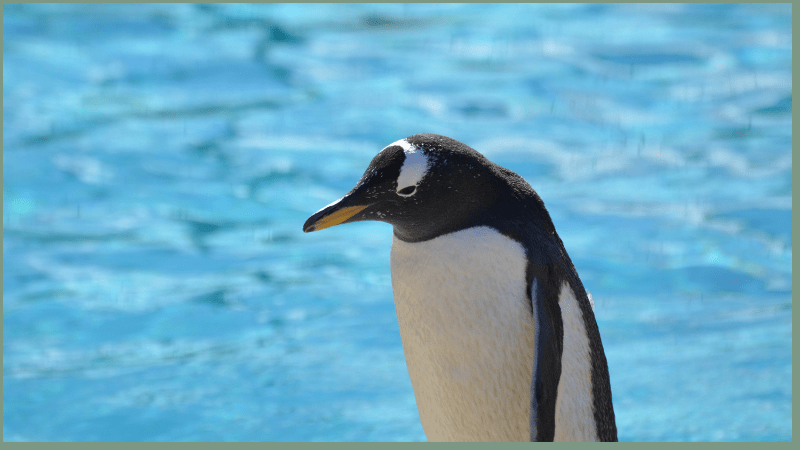
However, these are not apparent in larger penguin species like the Emperor Penguin since they fold their legs at the knee to keep them close to their body.
Smaller penguins like the Galapagos, on the other hand, move quickly with their flippers, clearly exposing their legs while doing so.
Some penguins, like the King Penguin, even use their legs to keep their eggs warm in a pouch between them.
So, no matter what penguin we are referring to, the reality is that all of them have legs and feet.
Do Penguins Have Knees?
You may be wondering: if penguins have legs, do they also have knees?
That’s an understandable question, especially because penguins’ legs are so short and practically invisible. You wouldn’t even think about their legs having more than just one part, right?
Well, you’d be surprised to know that penguins also have knees that help them in moving around. In fact, despite appearances, both of their legs have 4 parts, which include their knees.
The other 3 parts are the following:
- Femur
- Fibula
- Tibia
These little creatures use their knees for a range of purposes despite having them hidden beneath their fat and feathers.
This is also why we see them waddle around with their flippers when they walk on land. When they swim through the water, though, their knees, along with their legs and powerful flippers, allow them to swim quickly.
As you have already figured, Penguins are quite unique from their avian cousins. Instead of a light skeleton that is common for most birds, penguins have a denser skeleton which allows them to dive deep into the water and have fantastic swimming abilities.
But, the question still remains: why do they tuck their legs and knees so close to their bodies?
The first reason is that they need to conserve as much body heat as possible.
If you were a bird that constantly faces the harsh winds of the Antarctic, you would also be forced to adapt to the climate to prevent heat loss. This is what our penguin friends have done for themselves.
As an evolutionary trait, penguins have tucked their legs close to their bodies to ensure survival by retaining the heat in their body since they face the cold climate every single day.
Secondly, their short legs and knees allow their body to be streamlined and hydrodynamic.
This is more ideal compared to long legs since a longer leg would just add to the drag and friction, making penguins slower while swimming through the water.
This trait is so essential for penguins since they spend most of their lives swimming through the ocean to hunt for food. This is also why instead of wings, penguins have flippers, and instead of tails, penguins have rudders.
Lastly, they don’t have much reason at all to walk (waddle) around.
Because of the absence of many predators on land, penguins don’t have much need to run or waddle. Besides, why waddle if they can just use their bellies to cover the distances they need, right?
This is not to say that they can’t walk (waddle). They do. It’s just that because their legs and knees are tucked close to their body, that they don’t walk normally as other birds do. Instead, they waddle around and slide through the ice as they see fit.
Do Penguins Use Their Knees To Walk?
In short, yes, penguins use their knees to walk. But we need to answer this question with more nuance.
For instance, a bird or human will typically walk by lifting a part of its body with each step they take. Since penguins have very short legs and knees, walking the typical way will cost them more energy, tiring them out in just a few steps.
To save their energy, our penguin friends walk by lifting their feet first and then rotating forward, which is precisely how a pregnant woman would walk. If you don’t know it yet, this is what we call waddling.
Their strange walk, which is a result of their knees and legs tucked close to their body, is an evolutionary trait. Unlike other birds you see, penguins are largely aquatic animals, which means that land and air are not their domain. They live most of their lives swimming in the sea, swimming for food to survive.
Furthermore, since most of their predators live in the sea, they need their knees to be the most functional while swimming. Their knees can help them escape some of the best hunters in the ocean, including leopard seals, sea lions, sharks, killer whales, and fur seals.
Final Thoughts
Penguins’ unique leg structure just adds to the countless reasons why we love them!
Sure, their legs may not look much, especially since we don’t see them a lot, but their legs play a vital role in their survivability. From walking on land to swimming the seas to taking care of their babies, penguins have a lot going on that needs the help of their legs.
Finally, it is important to remember that our penguins need to be cared for, so make sure to express your love for them by contributing to efforts to conserve and protect them for generations to come!
References:
https://seaworld.org/animals/all-about/penguins/physical-characteristics/

